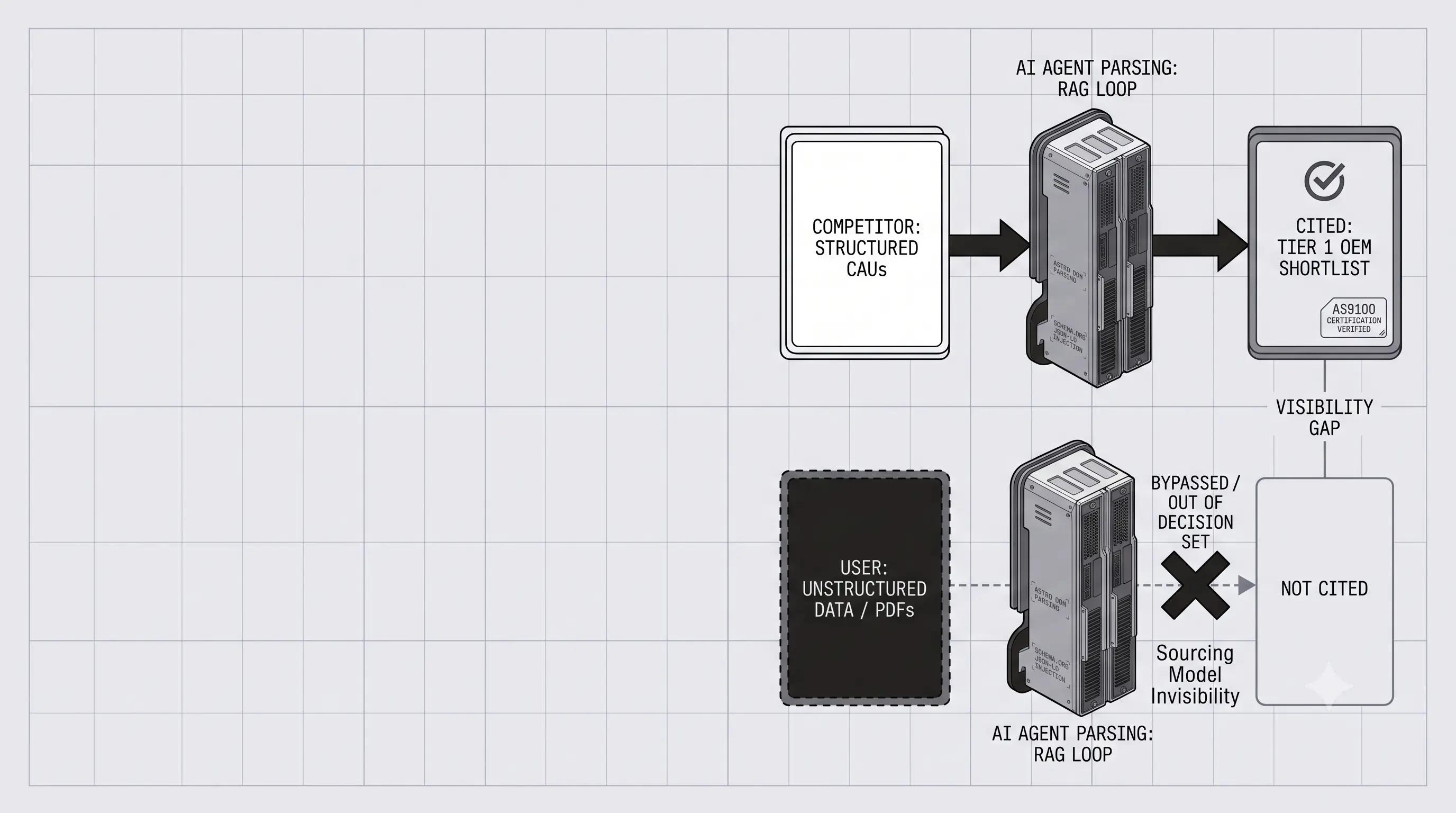
When a Tier 1 aerospace procurement officer asks SearchGPT to identify AS9100-certified CNC machine shops in the Cali-Baja region with 5-axis travels exceeding 750 millimeters and the capability to process titanium alloys, your facility's multi-million dollar capital investments are locked out of the selection loop if your technical parameters are buried inside a non-indexed PDF catalog or a flash-based image gallery. Legacy manufacturing websites hosting capabilities inside unstructured formats are bypassed by AI sourcing models because large language model (LLM) parsers cannot programmatically extract specific machine axis limits, materials processing specifications, or micron-level tolerances. This operational blind spot, known as Sourcing Model Invisibility, forces modern AI search engines to bypass legacy manufacturer domains and instead recommend competitors who have structured their technical floor variables into machine-readable, schema-backed databases.
Key Takeaways
- Traditional Search Engine Divergence: According to data from the Semrush study: “AI visibility: What it is and how to grow yours in 2026", only 44.3 percent of pages ranking in Google's traditional top 10 search results overlap with generative artificial intelligence citations, with ChatGPT exhibiting an overlap of only 2.1 percent and Google AI Overviews registering 8.3 percent.
- Third-Party Signal Dominance: Data from the Lantern AI Citation Content Visibility Report reveals that 91 percent of generative artificial intelligence citations originate from independent third-party platforms rather than owned brand websites, with YouTube transcripts representing 3.10 percent of global citations and showing a 0.737 correlation with brand visibility.
- Algorithmic Freshness Mandate: Ahrefs and Seer Interactive studies establish that crawled artificial intelligence bot URLs are 25.7 percent fresher than traditional organic search engine results, driven by an algorithmic index where nearly 90 percent of pages crawled were published within the last three years.
- Quantifiable Referral Velocity: Semrush research and Lantern conversion datasets indicate that business-to-business buyers arriving via artificial intelligence search tools convert at 4.4 times the rate of standard organic search traffic, delivering an average conversion rate of 14.2 percent compared to only 2.8 percent for standard organic Google visits.
How Do Generative Search Engines and AI Procurement Agents Evaluate Shop-Floor Capabilities?
Generative search engines evaluate potential B2B contract manufacturers by parsing indexed web content into semantic chunks, scoring each chunk for capability relevance, and verifying entity authority against third-party trust databases. AI assistants do not browse websites like human consumers; they break articles into distinct passages, assess those passages for absolute factual density, and synthesize an answer. When an AI crawler indexes a page, it constructs linguistic semantic triples to map conceptual relationships, associating specific entities—such as a manufacturing facility name—directly with explicit technical predicates, such as titanium processing or metrology validation.
This retrieval process is highly selective, creating a substantial divergence between standard search engine results pages (SERPs) and generative summaries. According to research conducted by Semrush, only 44.3 percent of pages ranking in Google's traditional top 10 search results overlap with the pages cited in generative AI answers. The overlap varies dramatically by platform: ChatGPT has a citation overlap of only 2.1 percent, Google AI Overviews has 8.3 percent, Google AI Mode has 15.5 percent, and Perplexity has a 32 percent overlap with traditional top 10 organic results. This metric proves that having a traditional search position on Google does not guarantee visibility inside the answer layer that modern buyers utilize to pre-screen vendors.
Furthermore, AI models evaluate website freshness as a critical trust proxy when answering commercial and comparison queries where manufacturer capabilities or certifications may have shifted. According to research published by Seer Interactive, nearly 90 percent of pages crawled by AI bots were published within the last three years. This dataset is further supported by an Ahrefs study documenting that URLs cited by AI search tools are 25.7 percent fresher than those cited by traditional organic search engines, with older URLs actively pushed further down the list of answers inside ChatGPT and Perplexity. If your website content has not undergone a structural update within the past twelve months, AI engines deprioritize your capabilities, assuming the data is stale or obsolete.
Why Are Legacy PDF Portfolios and Image-Heavy Websites Structurally Invisible to Large Language Models?
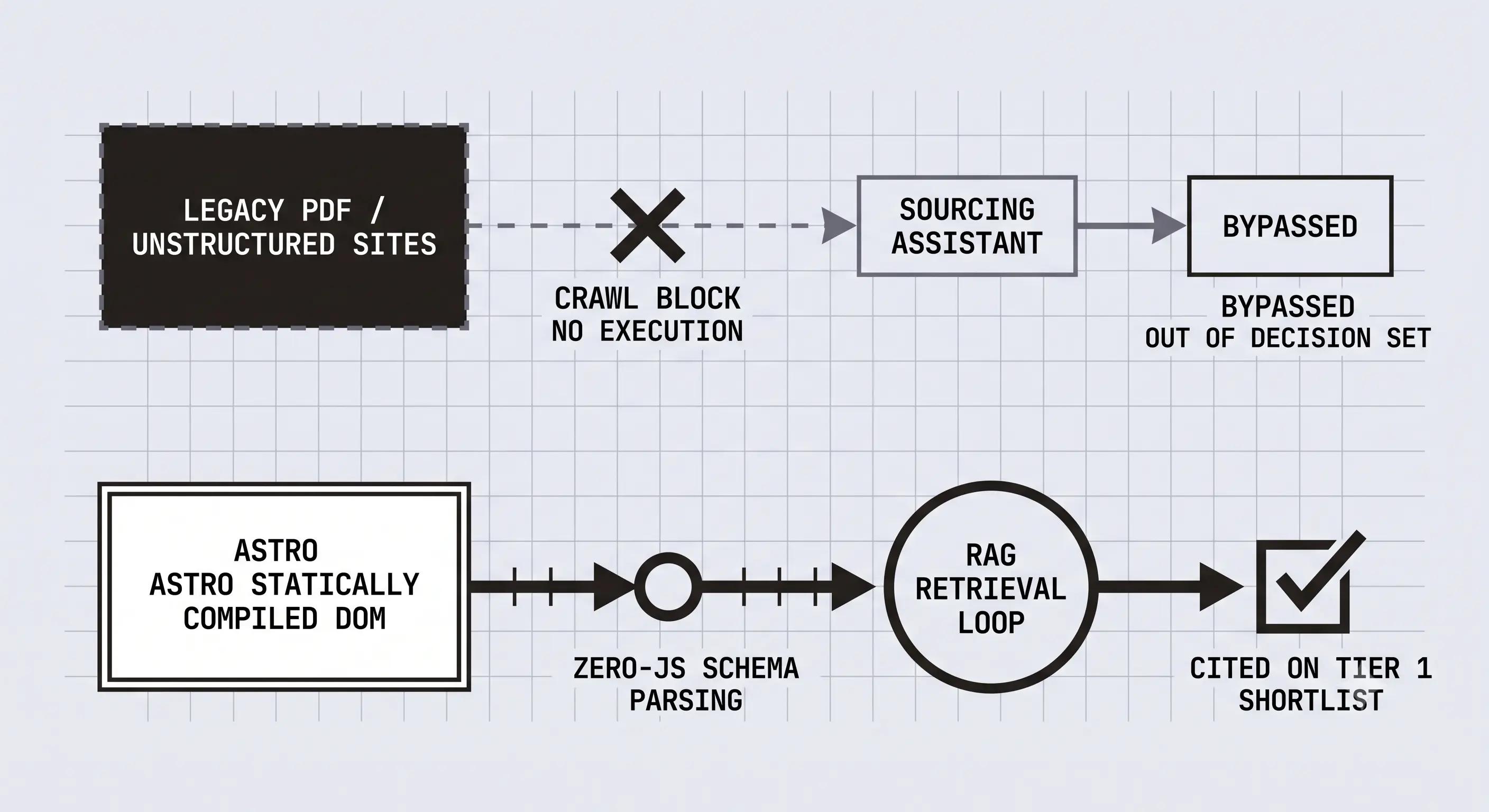
Legacy websites running dynamic, client-side rendered elements and unmanaged PDF attachments prevent AI models from executing the Retrieval-Augmented Generation (RAG) loops necessary to justify vendor recommendations. Many AI crawlers do not execute JavaScript files; they read raw HTML code. If your equipment list, coordinate travels, spindle speeds, or certification parameters require client-side execution to render on a screen, the AI scraper records a zero-capability blank state.
Similarly, physical capabilities cataloged inside legacy PDF portfolios are functionally invisible. According to the Lantern AI Citation Content Visibility Report (February 2026), ChatGPT alone processes over 400 million weekly active users and drives 87.4 percent of all AI referral traffic across B2B domains. If ChatGPT's parser cannot crawl or extract text strings from your scanned PDFs, your facility is excluded from the referral stream.
AI models are designed to minimize their own risk of providing inaccurate recommendations; therefore, they prioritize external, independent validation over self-interested brand claims. A website home page that claims a shop is "the leading precision manufacturer" provides zero objective signal to an LLM. Lantern's analysis of over 200 million citations shows that 91 percent of AI citations originate from third-party platforms rather than owned brand websites. When an AI assistant constructs a response, it triangulates self-reported website claims against:
- Independent review aggregators (e.g., G2 and Capterra, which represent 1.66 percent of all global AI citations according to Lantern).
- Video transcript indexes (e.g., YouTube, which is the single most cited domain in AI search, representing 3.10 percent of all citations).
- Community platforms (e.g., Reddit and LinkedIn), where real operators discuss physical capabilities.
If your facility lacks a coordinated digital footprint across these third-party domains, the AI engine cannot verify your claims and will bypass your site in favor of a competitor with documented off-site authority.
How Do Competitors Build Machine-Readable Capability Datasets to Secure Tier 1 OEM Vendor Shortlists?
High-performance B2B websites optimize for Generative Engine Optimization (GEO) by deploying Astro-React frontends that compile into zero-client-side JavaScript HTML, ensuring that search engine bots and AI crawlers can index text strings instantly without execution rendering overhead. By utilizing static compiled structures, like those built under the Astro framework, you eliminate browser execution memory overhead, lower dynamic database vulnerabilities, and maintain a sub-1.2 second First Contentful Paint (FCP) across globally distributed CDN nodes, satisfying both traditional search engines and rapid-crawler scraping budgets.
To bridge the gap between physical machine capabilities and algorithmic indexation, competitors implement the following technical architecture:
- Schema.org JSON-LD Injection: This structure nests structured metadata directly within the HTML document head. It defines your precise CNC tooling axis limits, Swiss turning maximum machining diameters, and AS9100 quality certifications using standardized, noun-dense arrays that crawlers read as citable facts.
- Citable Authority Units (CAUs): You must author all technical text as modular, self-contained sentences with strict noun-density, completely eliminating lazy pronouns ("this," "it," "our systems"). This allows LLM scrapers to extract and cite your claims without pronoun ambiguity.
- Omnimedia Integration: Competitors script YouTube video walkthroughs using identical, noun-dense protocols. Because YouTube is the most cited domain in AI search and exhibits a 0.737 correlation with AI visibility, a video transcript detailing a complex setup serves as an ideal citation source for high-stakes sourcing queries.
- LLMs.txt Deployment: This text file, hosted at the root directory, provides an explicit, highly condensed capability and certification manifest structured specifically for programmatic LLM ingestion, bypassing the need for models to crawl unrelated marketing pages.
What Steps Are Required to Close Your AI Sourcing Visibility Gap in the Next 90 Days?
Closing your AI sourcing visibility gap requires a rigorous transition from legacy, relationship-dependent marketing to an automated, schema-backed Authority Hub. This transition has a direct, quantifiable impact on your corporate performance. According to Semrush research, B2B buyers arriving via AI search tools convert at 4.4 times the rate of standard organic search visitors. Furthermore, Lantern’s B2B conversion data indicates that AI-referred visitors convert at an average rate of 14.2 percent, compared to only 2.8 percent for standard organic Google traffic. These visitors are pre-qualified; the AI assistant has already validated their technical specifications against your documented capabilities before directing them to your site.
To systematically eliminate Sourcing Model Invisibility, you must implement a multi-phase system transition, as demonstrated by the real-world operational turnaround of Vance Precision LLC in the Cali-Baja Binational Megaregion.
The 90-Day System Restructuring Playbook:
- Month 1: Execute a Technical Sourcing Audit and Profile Mapping
- Run a diagnostic audit of fifty to one hundred real-world buyer queries across ChatGPT, Perplexity, and Gemini to identify missing prompts where competitors appear but your brand does not.
- Map your target buyer profiles and isolate your highest-margin capabilities (e.g., Swiss turning, aerospace alloy processing) to establish precise campaign performance benchmarks.
- Month 2: Refactor Digital Infrastructure into a Statically Compiled Authority Hub
- Deprecate your outdated CMS and deploy a decoupled Astro-React site generator to compile your entire capabilities database into static, zero-JS HTML layouts.
- Inject Schema.org JSON-LD arrays into the HTML document head, cataloging your tooling travels, micron-level tolerances, and active compliance standards.
- Month 3: Build Off-Site Trust Signals and Deploy Conversion Telemetry
- Establish active profiles on high-authority directories, G2, and Capterra, and prompt your top customers to post reviews detailing measurable operational outcomes.
- Integrate customized Google Tag Manager (GTM) containers to record non-PII conversion milestones, and deploy targeted paid search campaigns using Google Ads Single Theme Ad Group (STAG) structures to capture active, long-tail technical queries.
By replacing unstructured, broad-match content with a highly targeted semantic search architecture, Vance Precision LLC transitioned from a chaotic, owner-dependent job shop with only two weeks of backlog visibility into an institutionalized, highly valuable revenue engine with a secure 12-month contract backlog, a +255 percent expansion in audited manufacturing revenue, and an ISO 9001:2015 certified quality posture. Resolving your AI sourcing visibility gap is not a cosmetic marketing project; it is a critical infrastructure upgrade that protects your gross margins, eliminates single-point-of-failure risks, and permanently secures your strategic corporate valuation.